

Hotel Website Templates: Define the Booking-System Scope
Does a hotel website template include a working booking system?
On this page
Does a hotel website template include a working booking system?
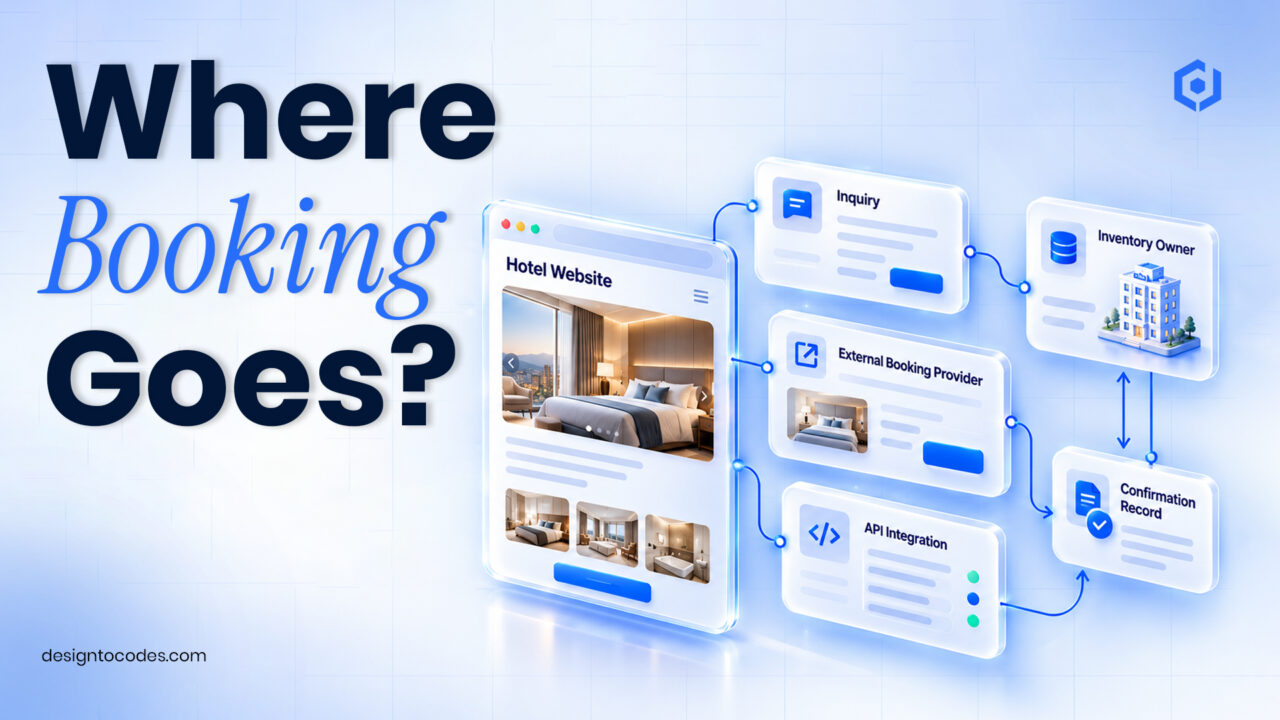
A hotel website template may provide room pages and a booking interface without processing reservations. Before buying, identify where availability is stored, how inventory is reserved, and which system issues confirmation. Choose between an inquiry form, an external booking engine, and a custom integration based on the hotel’s actual operating process.
This distinction applies across Next.js, Framer, WordPress and HTML websites. The framework does not tell you whether a reservation system is included. A polished date selector can be a demonstration, a link to another service, or part of a real integration; inspect the specific package and provider arrangement.
Compare the three booking routes
| Route | What the guest does | What your team must provide | Safe wording for the website |
|---|---|---|---|
| Inquiry only | Requests dates and waits for a response | Staff availability check and confirmation process | Request availability |
| External booking engine | Completes a provider-managed booking journey | Provider account, inventory configuration and tested connection | Book online, if the workflow actually confirms reservations |
| Custom reservation integration | Uses an interface connected to reservation services | Developer implementation, inventory rules, payment and recovery logic | Describe only the confirmed behavior |
An inquiry route can be an intentional choice for a small property. The problem is presenting an inquiry as a confirmed reservation. Guests need to know whether their room is held, whether payment has occurred, and what happens next.
Step 1: Name the inventory owner
Ask the hotel’s operations team which system owns room availability and prices. The answer may be an existing property-management system, a channel manager, or a separate booking provider. Get the name and responsible person before discussing the website interface.
If several channels sell the same rooms, ask how reservations update availability across those channels. Do not assume that a website template manages synchronization or overbooking. Those are system behaviors that need a provider-supported arrangement and appropriate testing.
For broader design selection, use the hotel template selection guide. This article focuses on the booking boundary and acceptance test, so it does not need to repeat another general hotel-template roundup.
Step 2: Write the booking acceptance test
| Test | Expected evidence | Question if evidence is missing |
|---|---|---|
| Available room and dates | Correct room, dates, and price from the designated source | Is this live inventory or sample data? |
| Unavailable dates | Clear explanation and a useful alternative | What prevents a conflicting reservation? |
| Changed dates or guest count | Updated details before confirmation | Which system recalculates the offer? |
| Confirmation | Identifier and status from the actual reservation system | Is the response a request acknowledgment or a confirmed booking? |
| Payment, if required | Provider-supported test transaction and correct reservation status | What happens when payment fails? |
| Duplicate submission | Defined response that avoids duplicate operational records | Who handles repeated requests? |
| Follow-up or cancellation | Clear route and owner consistent with the hotel’s policy | Which system controls the change? |
Use a provider sandbox or another approved test arrangement where available. Do not create real guest reservations, process a live payment, or change production inventory just to test a template demo. Confirm the permitted test procedure with the system owner.
Worked example: a small hotel keeping its existing booking provider
This is an illustrative implementation brief. A twelve-room hotel already manages reservations in a provider’s dashboard. It wants a new website because room descriptions and photographs are difficult to update.
The website project therefore has two scopes. The template supplies room presentation and navigation. The existing provider continues to manage reservation processing. The implementation must preserve the intended room and date context when a guest moves into the provider’s booking journey.
The acceptance test follows a guest from one room page to the provider confirmation, then checks the reservation record in the approved test environment. A screenshot of a “Book” button would not satisfy that test. Neither would a front-end thank-you screen without a reservation identifier.
Step 3: compare template scope using the same brief
SeaHotel is a Next.js hotel-template candidate. Review its current page, preview, and package information against the brief; do not infer a complete backend from its room interface. If your team wants a code-owned implementation, its layout may be a starting point while reservation services remain separate.
Compare other relevant entries in the template library using the same requirements. A different stack can still fit the same provider-led booking route. The Framer and Next.js comparison helps assign editing and maintenance responsibilities rather than ranking frameworks by imagined hotel revenue.
Step 4: cost the integration and ongoing operation
Write down the template purchase, customization work, provider charges, hosting or publishing, integration support, and future updates. Confirm whether payment fees or booking-service charges belong to a separate contract. Use the provider’s current terms rather than a price remembered from another project.
Ask who notices a failed integration. Define a recovery route that operations staff can actually use: a visible inquiry alternative, a provider contact, or a documented support process. Do not silently convert a confirmed-booking promise into an unmonitored email request.
Measure the booking journey correctly
Separate room-page visits, booking-button clicks, provider arrivals, and confirmed reservations. The website may observe the first steps while the provider records the final booking. If tracking crosses domains, verify the arrangement rather than treating a button click as revenue.
Compare reservations with the provider’s records over a consistent reporting window. Explain cancellations and refunds separately. A new template can change presentation, but without measured booking data you cannot claim it improved occupancy or revenue.
Frequently asked questions
Is a date picker proof of live availability?
No. Ask where the data comes from and test the approved inventory connection. A demo may use sample values.
Can I keep my existing booking provider?
Possibly, if it supports the required link, embed, or integration and the template can accommodate that route. Confirm provider requirements and the package’s actual scope.
Does Next.js make a hotel website a reservation system?
Next.js supports application development, but the framework name does not establish included inventory, payment, or booking logic. Those features need explicit implementation evidence.
What should a hotel inquiry form say?
Explain that the visitor is requesting availability and how the hotel will respond. Avoid confirmation language until a reservation has actually been accepted.
Which event should count as a booking conversion?
Use the reservation system’s defined successful-booking event or confirmed record. Report inquiries and button clicks as separate supporting steps.
SeaHotel Next.js hotel-site layout. Compare its current format and included scope with the task in this guide.
Related reading
Sources and platform references
Recent Posts



Recent Blogs
From the Journal

Does a hotel website template include a working booking system?
- Oct 17, 2026
- 1:11 PM

How do you turn kitchen-project photos into a useful case
- Oct 13, 2026
- 11:46 AM
How do you build a gym class timetable that stays
- Oct 10, 2026
- 11:59 AM

How should a service business build service-area pages? Build service
- Oct 06, 2026
- 5:51 PM