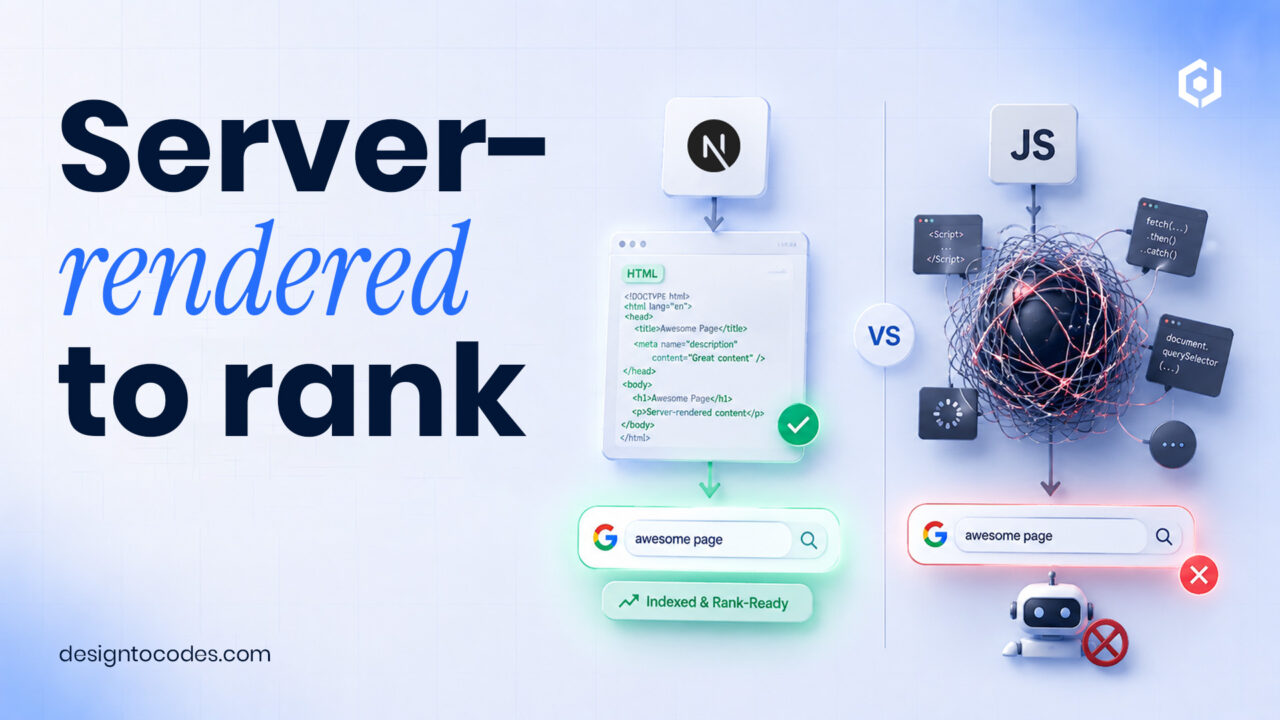
Is Next.js good for SEO in 2026?
Yes — Next.js is one of the strongest frameworks for SEO in 2026. It server-renders complete HTML that crawlers and AI engines can read, handles metadata, sitemaps and canonicals natively without plugins, and is built around Core Web Vitals. The one caveat: a misconfigured Next.js app can undo all of that, so the framework helps only when you use it correctly.
Why Next.js helps SEO
- Server-rendered HTML by default. With the App Router, content arrives in the initial HTML instead of being painted by client JavaScript — so Googlebot and AI crawlers read the full page reliably.
- The Metadata API. Per-route titles, descriptions, canonicals and Open Graph tags are defined in code, no SEO plugin required.
- Sitemaps and robots as code.
sitemap.ts and robots.ts Generate the files automatically and keep them in sync.
- Core Web Vitals support.
next/image, next/font And Server Components make fast, stable pages the default path.
- Clean, controllable URLs and structured data. File-based routing and easy JSON-LD injection give you the technical scaffolding for search rewards.
The Metadata API in practice
export const metadata = {
  title: 'Free Business Website Templates',
  description: 'Fast, SEO-ready templates you can launch today.',
  alternates: { canonical: 'https://example.com/templates' },
}
That single export gives the route a proper title, description and canonical — the things you’d otherwise wire through a plugin and hope rendered.
Where Next.js can hurt your SEO
- Overusing client components. Mark everything,
'use client' and you push content back into JavaScript, defeating the server-rendering advantage.
- Unoptimized images and fonts. Skipping
next/image/next/font Thanks, Core Web Vitals — a ranking signal.
- Wrong rendering choice. Client-side rendering a page that should be static or server-rendered hides content from crawlers.
- Redirect and canonical mistakes. Easy to introduce in code; easy to forget to test.
Next.js vs other options for SEO
For content-heavy marketing sites, Astro can ship even less JavaScript and is excellent for pure SEO. WordPress still wins on plugin ecosystem and non-technical editing. Next.js is the strongest pick when you want one framework for a fast marketing site and a dynamic app, with full control over rendering and metadata. There’s no universally “best SEO framework” — there’s the best fit for your team and content.
The honest verdict
Next.js doesn’t make a site rank by installing it; it removes the technical obstacles that hold sites back and makes the fast, crawlable, well-tagged path the default. Use server rendering, the Metadata API, and the image/font tools, and it’s genuinely one of the best SEO frameworks available. Ignore them, and it’s just React with extra steps.
Frequently asked questions
Does Next.js automatically make my site SEO-friendly?
No. It provides the tools — server rendering, the Metadata API, image and font optimization — but you have to use them. A misconfigured Next.js site can still rank poorly.
Is Next.js better than WordPress for SEO?
For technical SEO and performance, Next.js gives you more control. WordPress wins on ease of editing and its plugin ecosystem. The better choice depends on your team and how dynamic the site is.
What is the best framework for SEO in 2026?
There isn’t one universal answer. Astro excels for content-only sites, Next.js for sites that are part marketing and part app, and WordPress for non-technical teams. All can rank well when built correctly.