
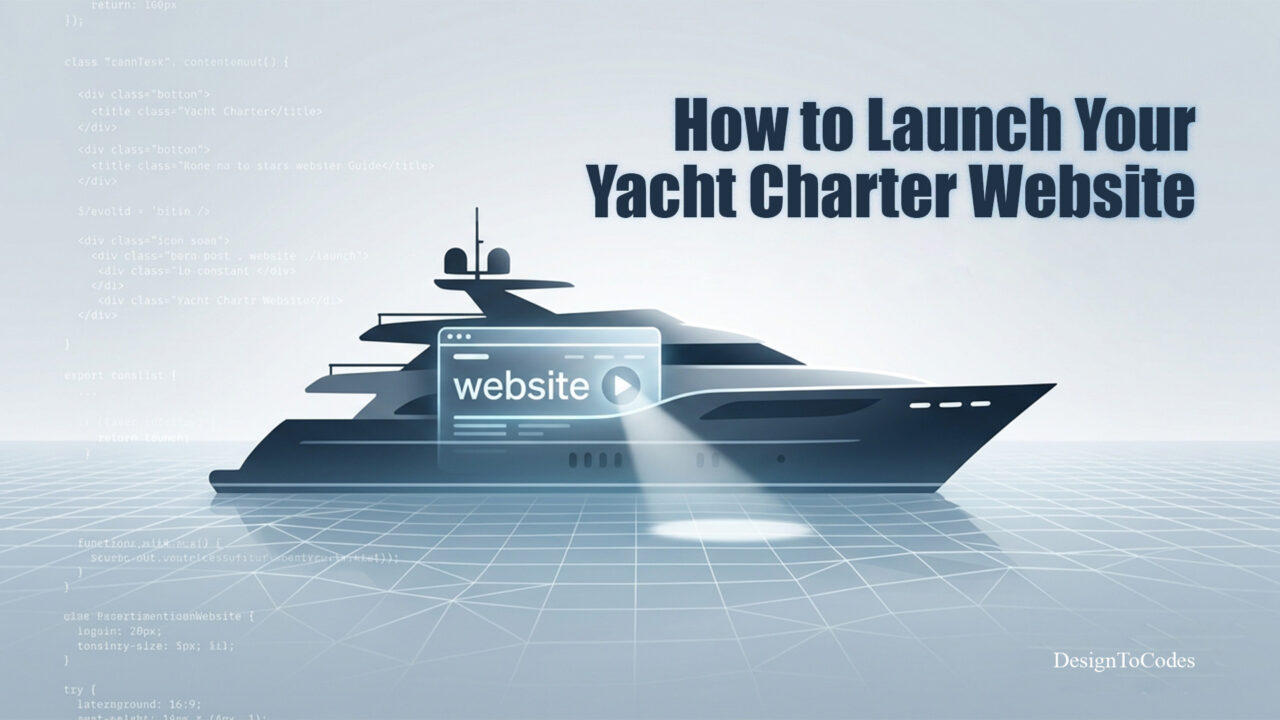
How to Launch a Yacht Charter Business Website in 2026: A Founder’s Guide
Launching a yacht charter business website in 2026 is no longer a nice-to-have line item on a founder’s checklist. It is the storefront, the booking desk, the brochure, and the trust signal — all stitched into one experience that travelers will judge in roughly six seconds. For first-time charter operators, that compression of decisions can feel disorienting. There is the marina photography, the fleet inventory, the calendar tool, the deposit flow, the SEO basics, the local marketing push, and somewhere underneath it all, a real business that needs to take real bookings. This founder’s guide breaks down the entire process into clear, sequential steps, allowing a founder to move from a blank domain to a working yacht charter business website without burning a season’s worth of revenue.
What a Yacht Charter Business Website Actually Has to Do
Before debating frameworks, themes, or photography styles, founders should anchor the project to a single question: What does the site need to do in the first ninety days of operation? In practice, four jobs sit at the top of every successful charter site. The site has to convert a curious visitor into a booking inquiry, surface enough fleet detail to support a confident decision, prove the operator is real and seaworthy, and load fast on a phone in a marina parking lot with a weak signal. Every other decision flows from those four jobs.
A common founder mistake is to chase a beautiful homepage while neglecting the booking funnel that sits under it. Beauty is good. Beautiful that does not book is a postcard. The order of priorities, in plain language, looks like this:
- Booking flow first — date picker, party size, yacht selector, deposit policy, contact capture.
- Fleet detail second — clear specs, photo galleries, capacity, crew details, pricing windows.
- Trust signals third — reviews, certifications, insurance, captain bios, and marina permits.
- Storytelling fourth — the brand voice, the routes, the experiences, the editorial polish.
Founders who flip that order tend to ship gorgeous sites that do not earn their hosting bill. Founders who follow it ship modest sites that pay for themselves before the high season ends.
Concept: a yacht charter site is not a magazine cover. It is a reservations desk that happens to look beautiful. Every pixel either supports a booking or politely steps aside.
The Seven Sections Every Yacht Charter Website Needs
After auditing dozens of charter sites in the Mediterranean, the Caribbean, and the U.S. East Coast, the same seven sections appear on every site that is actually closing inquiries. Founders should treat this list as a non-negotiable starting kit, then layer differentiation on top.
- Hero with intent — a single line that explains what charter the operator runs, where, and for whom. Not “Welcome to paradise.” Something like “Half-day and full-day catamaran charters from Marina di Portofino, May to October.”
- Fleet catalog — every yacht has its own listing with capacity, crewed/bareboat, length, year, sleeping berths, and a clear photo set. Each yacht needs its own URL for SEO and for sharing.
- Pricing and policies — at least a starting-from rate, what is included, deposit terms, and cancellation rules. Hidden pricing kills inquiries.
- Trust block — reviews from prior charters, insurance and certification logos, captain bios, and marina permits.
- Booking flow — calendar availability, party size, request-to-book form or instant booking, and a clear confirmation experience.
- Contact and concierge — phone, WhatsApp, email, and physical marina address. International travelers expect a same-day reply.
- Journal or blog — short articles about routes, weather windows, and itineraries. This is the SEO engine that brings new founders organic traffic.
If a section is missing from the launch site, the founder is leaving inquiries on the table. The good news: every modern template — including the production-ready yacht templates in the D2C catalog — ships with these sections wired in.
Common Mistakes Charter Founders Make
Founders rarely fail because they pick the wrong shade of teal. They fail because of a small set of recurring strategic mistakes that compound. Here are the ones to avoid in 2026.
- Over-designing the homepage and under-designing the funnel. A cinematic hero is fine. A four-step inquiry form that takes ninety seconds to complete is not.
- Building a “beautiful brochure” with no real booking layer. A “Contact us” mailto link is not a booking flow.
- Ignoring local SEO. Most charter searches start with a port name plus “charter” or “yacht rental.” If Marina City is not on the homepage, in the title tag, and in the schema, the site is invisible.
- Skipping mobile. Charter buyers research from their phones, often on the dock. A site that loads in three seconds on broadband but eight seconds on 4G is losing inquiries.
- Hiding pricing. “Contact for a quote” is a bounce trigger for budget-conscious travelers comparing five operators in a single afternoon.
- Buying a builder lock-in. A platform that prevents export, charges per booking, or nests pricing inside an opaque page builder will be regretted in year two.
- Forgetting the journal. Without long-form content, the site has no organic search engine and depends entirely on paid ads to feed it.
Founders who systematically audit their site against this list before launch tend to launch a tighter, more conversion-friendly product.
Local SEO Basics for Yacht Charter Operators
Yacht charter is a local business stitched to a global discovery layer. A boat in Saint-Tropez has to show up for a couple in Texas planning a Mediterranean honeymoon. The good news for founders is that yacht charter SEO is not yet saturated in 2026; the bad news is that local SEO requires real work, not magic dust. The non-negotiable basics are simple to list and harder to execute consistently.
- Google Business Profile claim and verification — with the marina address, photos of the actual fleet, hours, and the website URL.
- Title tags that name the port — “Yacht Charter in Marina del Rey | Operator Name” beats “Yacht Charter Operator Name” every time.
- City and region pages — one page per port served, each with unique copy, fleet availability, and itineraries.
- Structured data — at minimum LocalBusiness, Product (for each yacht), and FAQPage. Search engines reward the operators who feed them clean data.
- Reviews — at least twenty real Google reviews before the season opens. Operators with under five reviews struggle to rank above directories.
For a deeper read on the SEO side, the D2C blog has a companion piece on why Next.js is the best framework for SEO in 2026 that pairs neatly with this guide. Founders who combine fast hosting with disciplined local SEO are usually the ones who get phone calls instead of crickets.
Mobile-First Design for the Marina Parking Lot
Most charter buyers do at least one device switch during their decision: dream on a laptop, decide on a phone. Plenty of inquiries arrive at 9:42 p.m. on a Tuesday, a shore excursion away from the actual yacht. A site that is heavy, image-bloated, and slow to interact ruins those moments. Mobile-first means three concrete things in 2026:
- Sub-three-second LCP on a mid-tier phone over 4G. That requires properly sized hero imagery, lazy-loaded fleet photography, and modern formats like AVIF or WebP.
- Sticky inquiry CTA on mobile so the booking action is never more than a thumb-tap away.
- Tap-friendly forms — date pickers that respect the OS, party-size steppers, and a phone-friendly email keyboard.
The yacht templates in the D2C catalog are tuned for these patterns out of the box. The Sailvu Next.js template is a strong starting point for performance-first founders, while the YachtX Framer template is the design-led pick for founders who want to iterate quickly without a developer on retainer.
Ship a charter site this weekend
One-time purchase. Lifetime access. No 30-plugin stack — just a clean, production-ready yacht template a founder can rebrand and launch.
DIY Builder vs Template vs Custom Agency: A Decision Matrix
The single most consequential decision a charter founder makes in the first ninety days is the build path. Pick wrong, and either the budget cracks or the launch slips by a season. The decision is rarely about taste; it is almost always about the business stage, technical comfort, and how much customization the brand actually needs in its first year. Use the matrix below as a starting frame.
| Business stage | Typical situation | Recommended approach | Estimated launch time |
|---|---|---|---|
| Pre-launch / 1–2 yachts | Validating demand. Need a credible site fast. Limited budget. | DIY builder or Framer template (e.g., YachtX Framer) | 1–2 weekends |
| Operating / 3–6 yachts | Real bookings, real revenue. Needs SEO, performance, fleet pages. | Premium Next.js template (Sailvu Next.js) | 2–4 weeks |
| Established / 7+ yachts | Multiple ports, brand-led, ready to invest in custom touches. | Premium WordPress / Elementor template + light dev (Sailvu WordPress) | 3–6 weeks |
| Luxury club/membership | Members, regattas, private fleet, club identity. | YatchyClub series — see the upcoming YatchyClub series hub | 4–8 weeks |
| Multi-region operator | Multiple countries, multiple currencies, complex tax / VAT. | Custom Next.js build (often starting from a template baseline) | 2–4 months |
Three observations are worth absorbing from this matrix. First, the median founder is somewhere between “operating” and “established,” and a premium template is overwhelmingly the right tool. Second, custom agency builds are a year-three problem for most operators, not a year-one one. Third, builder lock-in (the kind that makes export impossible) almost always becomes a regret by year two — pick a template that ships clean code and an exportable site.
Choosing the Right D2C Yacht Template by Use Case
The 2026 D2C yacht collection covers four frameworks and two product lines, which sounds complicated until it is mapped to use cases. Here is a working translation for charter founders:
- Performance-first, SEO-first founders — start with the Sailvu Next.js template. It is fast, server-rendered, and built for organic search. Great for operators who plan to invest in content marketing.
- Design-led founders without a developer — the YachtX Framer template is the same brand on Framer’s marketplace (the Sailvu name was unavailable), and it is unmatched for founders who want to iterate visually.
- Self-managed marketing teams — the Sailvu WordPress theme is the best fit for operators who already have a WordPress workflow and want their marketing manager to ship pages without engineering.
- Premium charter brands — the YatchyClub series, including the YatchyClub Next.js template, lean richer, darker, and more club-coded. Strong fit for high-touch luxury brands and yacht clubs.
- Cross-niche reference points — founders building hybrid travel-and-charter brands often borrow patterns from the Tripvanta travel agency Next.js template for itineraries, and from the Seahotel Next.js template for hospitality booking flows.
For a fuller side-by-side, the Sailvu and YachtX series hub compares all four framework variants in one place. Founders also browsing the 10 best yacht booking website templates for 2026 will find a wider field of options.
Budget Breakdown: Realistic Numbers for 2026
Budget conversations get fuzzy fast because every founder is anchored to a different reference point. Here is a clean breakdown for the three most common build paths, at 2026 U.S. market rates.
| Line item | DIY builder | Premium D2C template | Custom agency |
|---|---|---|---|
| Software/template | $192/yr (builder subscription) | $59–$99 one-time | $0 (built from scratch) |
| Design and customization | $0 (DIY) | $500–$2,500 (light dev) | $8,000–$25,000 |
| Hosting / year one | included | $120–$360 | $240–$1,200 |
| Photography (essential) | $1,500–$3,500 | $1,500–$3,500 | $1,500–$3,500 |
| Copy/content | $0 (DIY) – $1,500 | $0–$2,000 | $2,000–$6,000 |
| Year-one total | $1,700–$5,200 | $2,200–$8,500 | $11,700–$35,700 |
The pattern is consistent: a premium template lands within 30 percent of the DIY budget while delivering a site that looks closer to the custom agency tier. That is the practical case for the D2C catalog — a real production-ready foundation, no monthly lock-in, and code clean enough to extend later.
Trust Signals That Actually Move Bookings
Charter is a high-trust category. A traveler is paying a deposit on a six-figure asset that will sail away with their family on it. The site has to earn that trust without saying the word “trust” once. The signals that work, in order of impact:
- Real photography of the actual fleet — not stock images. Captains, crew, and recent guests on board.
- Verified review aggregates — Google reviews and a TrustPilot or charter-specific platform widget.
- Captain bios — full names, certifications, photos, and a sentence of personality.
- Insurance and licensing badges — Coast Guard, port authority, and insurer logos with a tooltip explaining each.
- Press or partner logos — every legitimate mention is worth showing, whether a regional travel magazine or a corporate partner.
- A clear refund and weather policy — written in plain English, not legalese.
Concept: trust is built by specificity. “Captained by Alessio, RYA Yachtmaster Offshore, fifteen seasons in the Aeolian Islands” outperforms “experienced crew” by an order of magnitude on conversion.
From Launch to Season One: A Ninety-Day Plan
Here is a tight ninety-day plan that has worked for first-time charter founders launching with a premium template. Adapt it to the local season and keep moving.
- Days 1–14 — buy domain, install template (Sailvu Next.js or YachtX Framer), import fleet content, write the first three city pages, take real photography.
- Days 15–30 — launch the site, claim the Google Business Profile, set up structured data, push the first five journal articles (itineraries, route guides, season Q&A).
- Days 31–60 — run a small paid pilot ($30–$60 per day) to two top routes, collect reviews from the first ten charters, and refine the booking funnel based on inquiry data.
- Days 61–90 — start outreach to regional concierges and luxury hotels, publish two long-form route guides per month, expand the fleet listings as new yachts are added.
This plan deliberately moves the site from “live and credible” in the first two weeks to “earning organic traffic” by day ninety. Founders who fall behind on journal articles tend to plateau; founders who keep shipping content keep compounding traffic for years.
Where to Go From Here
A yacht charter business website is a working asset, not a one-time project. Founders who treat it that way — investing in a clean foundation, real photography, disciplined SEO, and a steady drumbeat of journal content — tend to outperform competitors who relaunch every two years from scratch. The fastest path to that working asset, for most founders, is a premium template that ships with the right architecture, a sane code base, and a license that allows real ownership.
Three useful next reads from the D2C blog: the boat and yacht website templates D2C May 2026 collection (the full category overview), the Sailvu and YachtX series hub (the four-framework comparison), and the upcoming guide to the seven sections every yacht club site needs for founders skewing toward the membership and club end of the market. Founders who pair this guide with those three should have everything they need to ship a credible, conversion-friendly charter site this season.
Frequently Asked Questions
Q1. How much should a yacht charter founder budget for a website in 2026?
For a credible, production-ready yacht charter business website, plan on $2,200 to $8,500 in year one when starting from a premium template like Sailvu Next.js. That figure includes the template license, light customization, hosting, photography, and basic copy. DIY builders are cheaper up front but plateau quickly; custom agency builds rarely make sense before year three.
Q2. Do I need Next.js, Framer, or WordPress for a charter site?
The right framework depends on the stage and team. Next.js is the strongest choice for SEO and performance once the brand is operating. Framer is the fastest path for a design-led founder without a developer. WordPress is the best fit for marketing teams that already use it daily. The D2C catalog ships the same yacht template across all three, so the founder can pick by team, not by trend.
Q3. Should I show prices on a yacht charter website or hide them?
Show at least a starting rate. “Contact for pricing” is a bounce trigger for travelers comparing five operators on a single afternoon. A “from $X per half-day” anchor lets visitors qualify themselves and increases the inquiry-to-booking ratio because the founder is talking to qualified leads, not curious browsers.
Q4. How important is mobile performance for a charter site?
Critical. Most charter buyers research from their phones, frequently from cellular networks at the marina or on the road. A site that posts a sub-three-second largest contentful paint on a mid-tier phone over 4G converts meaningfully better than a heavier site. Premium templates from D2C are optimized for that exact scenario.
Q5. What is the fastest way to launch a yacht charter business website?
The fastest credible path is a Framer-based template that the founder customizes visually without a developer. The YachtX Framer template ships pre-built sections for fleet listings, booking inquiries, and journal posts. Most first-time founders launch in a single weekend and iterate from there.
Q6. Do I need a separate booking system, or can the template handle it?
For inquiry-based bookings (the most common model in 2026), the template’s form handler is enough at launch, especially when paired with a CRM or email automation tool. For instant-book operations with calendar availability across multiple yachts, integrate a dedicated booking engine like Bookeo, FareHarbor, or a custom Stripe-backed flow on the Next.js variant.
Q7. How does local SEO work for a yacht charter business?
Local SEO for charter is anchored to port and city names. Each port served should have its own page with unique copy, fleet availability, itineraries, and structured data. Add a verified Google Business Profile, schema for LocalBusiness and Product, and a steady cadence of journal articles. The D2C templates ship the schema and per-city page patterns out of the box.
Q8. Can a non-technical founder maintain a Next.js charter site?
Yes, with caveats. Day-to-day content updates (new yachts, journal posts, pricing changes) can be wired through a headless CMS so the founder edits in a friendly UI. Framework upgrades, deployment hiccups, and code changes still require a developer. Many founders pair a D2C template with a fractional developer for monthly maintenance.
Q9. How do trust signals affect yacht charter conversion?
Heavily. Real photography of the actual fleet, verified reviews, captain bios with credentials, and visible insurance and licensing badges measurably move inquiry rates. A site that looks polished but anonymous converts worse than a slightly rougher site that proves a real operator with a real boat is on the other end of the form.
Q10. When should a yacht charter founder consider a custom agency build?
Usually in year three or later, after the brand has product-market fit, multiple ports, real revenue traction, and specific functionality that no template covers — multi-currency checkout, complex availability across crewed and bareboat fleets, or proprietary loyalty programs. Until then, a premium D2C template plus light development delivers ninety percent of the experience at a fraction of the cost.
Ready to launch? Start with the Sailvu Next.js template for performance-first founders, the YachtX Framer template for design-led launches, or browse the full boat and yacht template collection for every framework variant. The site that takes the next booking is the one shipped today, not the one perfected tomorrow.