
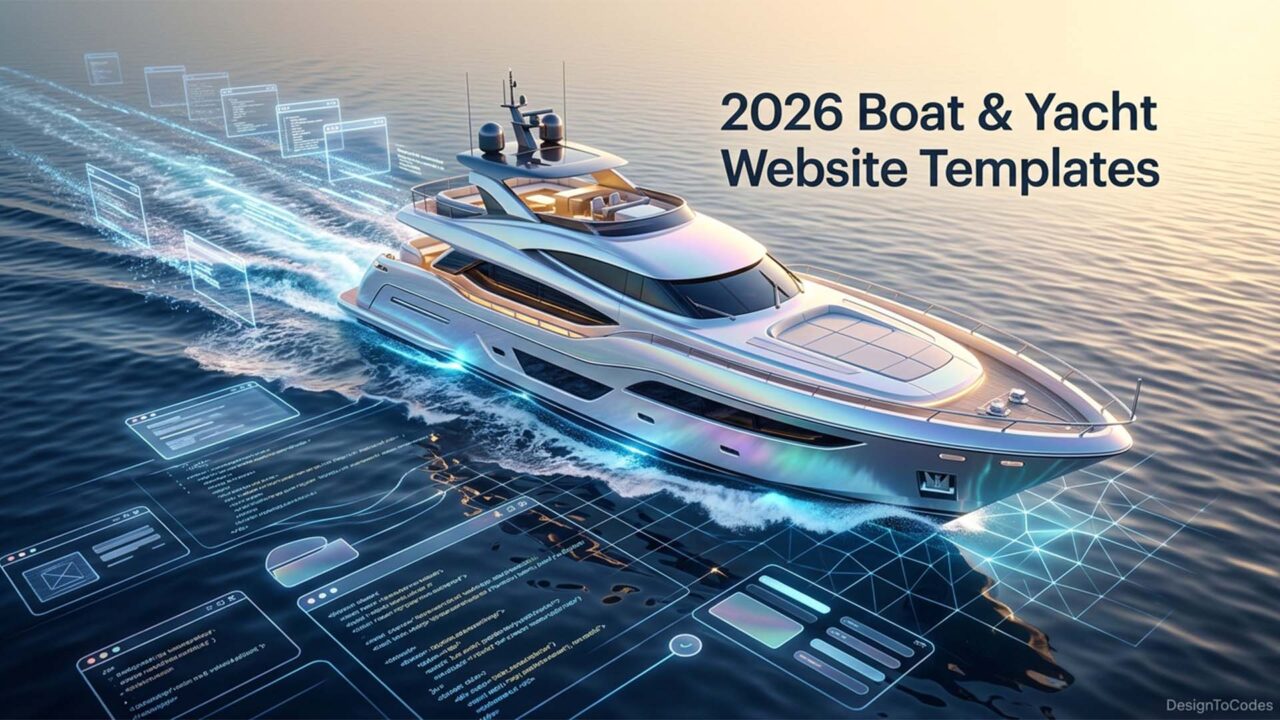
Boat & Yacht Website Templates: The DesignToCodes May 2026 Collection
The marine business web is having a quiet rebrand. Boutique charter operators are tired of bloated WordPress themes that need fifteen plugins to render a booking form. Established yacht clubs want member portals that don’t look like a 2014 forum. And the developers building for both keep asking the same question: where are the production-ready boat and yacht website templates that ship with clean code, no lock-in, and a one-time price tag? In May 2026, DesignToCodes answered that question with eight launches across four frameworks. This guide walks the entire collection, groups it by audience and tech stack, and helps you pick the right variant for your project — whether you run a single sailboat or manage a member-funded marina.
Rollout schedule: Two of these eight templates are available right now. The remaining six releases across May 2026 — exact dates noted next to each entry below. Bookmark this page or subscribe to the D2C newsletter to be notified as each variant goes live.
- Sailvu Next.jsAvailable now
- YachtX FramerAvailable now
- Sailvu ElementorAvailable May 13
- Sailvu WordPress ThemeAvailable May 15
- YatchyClub Next.jsAvailable May 18
- YatchyClub FramerAvailable May 22
- YatchyClub ElementorAvailable May 25
- YatchyClub WordPress ThemeAvailable May 29
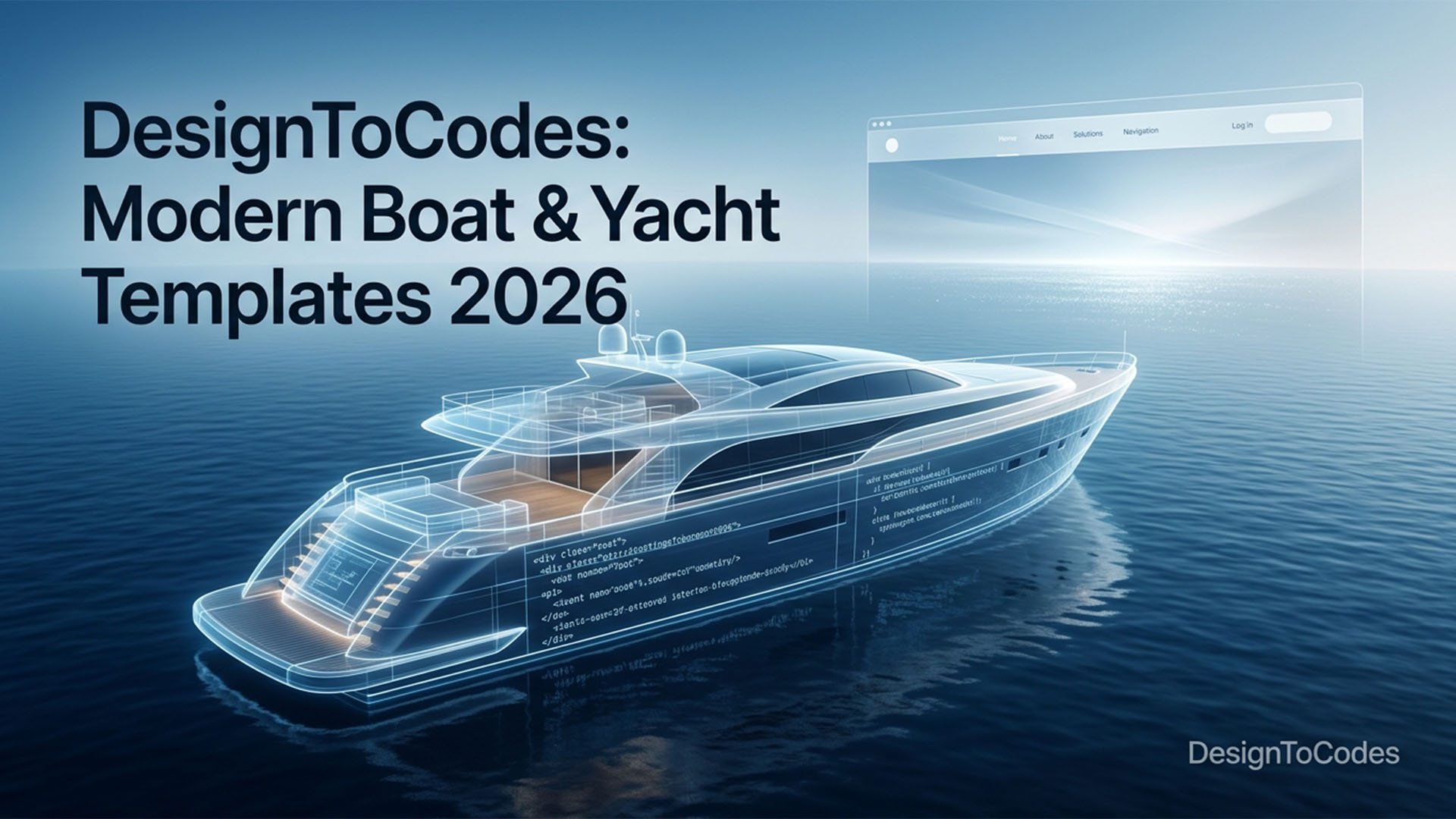
Why Marine Businesses Need Better Website Templates in 2026
Yacht charter and boat rental as digital categories sit in an awkward gap. They aren’t pure travel, they aren’t pure SaaS, and they aren’t generic real estate. The booking flow is heavier than a hotel (vessel availability, captain options, insurance, security deposit, weather window). The brand standards are higher than the average rental site (this is luxury, not budget). And the audience is split between two very different buyers: the boutique operator running two catamarans out of a Greek harbor, and the established yacht club managing 300 members and a regatta calendar.
Most marketplace themes flatten that distinction. They give every boat company the same slider, the same generic “Book Your Adventure Today” hero, and the same blog layout that nobody updates. The May 2026 collection from DesignToCodes was built deliberately the other way — two distinct visual languages (Sailvu for boutique, YatchyClub for premium club), each shipped in four framework variants so the buyer never has to compromise on tech stack.
The best yacht website is the one that loads in under two seconds, lets a guest see real boats with real prices, and gets out of the way. Everything else is decoration.
Two Product Lines, Eight Templates, One Quality Bar
The collection breaks into two clear product families. Sailvu (with its Framer edition shipping under the YachtX name on the Framer marketplace) targets boutique charter operators and modern boat rental companies. The aesthetic is bright, clean, and conversion-focused — large vessel imagery, pricing-forward listings, and a booking flow optimized for first-time renters. YatchyClub targets the premium end: established yacht clubs, luxury charter brands, and membership-driven marinas. The aesthetic leans darker, richer, and more editorial — long-form storytelling, member benefit grids, regatta calendars, and a tone that says “we’ve been on the water since before you were born.”
Both lines share the same engineering bar. Every template in the collection is responsive down to 320px, ships W3-validated markup, hits performance budgets in the green on Lighthouse, includes a documented design system, and comes with the DesignToCodes license: one-time purchase, lifetime access, no recurring fees, no plugin sprawl.
The Full May 2026 Boat & Yacht Collection at a Glance
Here’s the full release calendar with framework, line, and intended audience. Each row links to the live product page once available.
| Launch Date | Product | Framework | Line | Best For |
|---|---|---|---|---|
| May 4 | Sailvu Next.jsAvailable now | Next.js 14 | Sailvu (boutique) | Performance-first charter sites with custom backend |
| May 8 | YachtX FramerAvailable now | Framer | Sailvu (boutique, Framer marketplace) | Designer-led teams who want CMS without code |
| May 13 | Sailvu ElementorAvailable May 11 | Elementor / WordPress | Sailvu (boutique) | Operators with existing WordPress + WooCommerce |
| May 15 | Sailvu WordPress ThemeAvailable May 15 | WordPress (native theme) | Sailvu (boutique) | Lean WordPress installs, no Elementor dependency |
| May 18 | YatchyClub Next.jsAvailable May 18 | Next.js 14 | YatchyClub (premium) | Yacht clubs with custom membership APIs |
| May 22 | YatchyClub FramerAvailable May 22 | Framer | YatchyClub (premium) | Premium club brands with in-house designers |
| May 25 | YatchyClub ElementorAvailable May 25 | Elementor / WordPress | YatchyClub (premium) | Clubs running on WordPress with member plugins |
| May 29 | YatchyClub WordPress ThemeAvailable May 29 | WordPress (native theme) | YatchyClub (premium) | Editorial-heavy clubs with regular news/journal output |
Sailvu Line: Boutique Charter, Modern Boat Rental, Conversion-First
The Sailvu line is for the operator who runs two to twenty vessels and wants every visitor to leave with a quote. The brief was simple: build a fleet showcase that loads fast, a booking widget that doesn’t fight the user, and a brand system that holds up against larger competitors. Across all four frameworks, the Sailvu visual language is consistent — generous whitespace, vessel-first photography, and a typographic system that pairs a serif display face with a clean grotesk for body copy.
Functional patterns shared across the Sailvu variants:
- Fleet listing pages with filtering by vessel type, capacity, and charter duration
- Vessel detail pages with image galleries, spec tables, and an inline booking inquiry form
- Trip planner module that lets guests pick a route, dates, and add-ons before submitting
- Captain & crew pages for operators who hire out skippers
- Testimonials and trust modules are integrated into the homepage and booking flow
- Blog/journal layout for SEO-driven destination content
One detail worth calling out: the YachtX Framer edition. On the Framer marketplace, the name “Sailvu” was unavailable when the team submitted, so the Framer variant ships under the YachtX brand. The product is identical in design, system, sections, and customization — only the namespace differs. If you searched for “yachtx framer template” and landed here, you’re in the right place. The full breakdown is in the dedicated Sailvu & YachtX series hub.
YatchyClub Line: Premium Yacht Clubs, Membership, Editorial Tone
The YatchyClub line was designed for buyers further up the value chain — the established yacht club managing a member roster, the luxury charter brand with a fleet of over thirty, the marina operator running events and regattas. The visual system leans into darker palettes, gold and deep-blue accents, and an editorial layout that gives long-form content room to breathe. Member-coded UI patterns — gated portals, application forms, member directory blocks, regatta countdowns — are baked into every variant.
Functional patterns shared across the YatchyClub variants:
- Member portal entry (login wall, application form, “request membership” CTA)
- Fleet showcase with detailed vessel histories and spec sheets
- Events & regatta calendar with category filtering and ICS export hooks
- Member benefits grid showing tier-based perks
- News & journal editorial layout for club communications
- Application/contact pipeline with multi-step onboarding
- Sponsor & partner blocks for clubs with corporate relationships
The premium-club aesthetic isn’t just decoration. It signals legitimacy to prospective members who are evaluating whether your club is worth a five-figure annual fee. We dive deeper into specific sections in the 7 sections every yacht club site needs, and the full series breakdown lives in the YatchyClub series hub.
Framework Selection: How to Pick the Right Variant
Both product lines ship across the same four frameworks. The real question isn’t “Sailvu or YatchyClub” — that’s an audience decision. The harder question is which tech stack to commit to. Here’s the framework map.
| Framework | Setup Time | Best For | Avoid If |
|---|---|---|---|
| Next.js 14 | 2–4 hours (dev) for first deploy | Custom integrations, headless CMS, performance-critical sites | You don’t have a developer on the team |
| Framer | 30–60 minutes for first publish | Designer-led teams, fast iteration, no-code CMS | You need to plug in custom backend logic |
| Elementor | 1–2 hours on existing WordPress | Teams already on WordPress with paid Elementor | You don’t have WordPress hosting set up |
| WordPress (native) | 1–2 hours, no Elementor dependency | Lean WP installs, content-heavy sites, and editorial workflows | You want full visual editing without code |
A few practical notes:
- Next.js wins on raw performance and SEO. If your site is the primary acquisition channel, this is the variant. Pair with Vercel or Netlify, plug in any headless CMS, and you have a charter site that scores 95+ on Lighthouse out of the box.
- Framer is the fastest path from purchase to public URL. If you’re a single founder or a two-person team and you want to launch a yacht charter business website by the end of the week, Framer is the answer. The CMS handles fleet listings, blog posts, and events without writing a line of code.
- Elementor is the right call when WordPress is already a constraint. Maybe your booking plugin is WordPress-only (a lot of marine-specific plugins are). Maybe your team already knows the dashboard. The Elementor variant slots in cleanly.
- WordPress native is for teams who want WordPress without the Elementor overhead. The theme uses the block editor, ships clean PHP templates, and runs lean on cheaper hosting.
Ship your boat or yacht website this weekend
Pick the framework you already know. Get a production-ready template that’s been through the same quality bar as every other DesignToCodes release. One-time purchase, lifetime access, no 30-plugin stack.
Audience Mapping: Which Line Fits Your Business
The line decision is largely about brand maturity and audience expectation. Here is a practical decision matrix that helps narrow it down.
| Business Profile | Recommended Line | Why |
|---|---|---|
| 1–10 vessels, daily/weekly rentals, growing brand | Sailvu | Conversion-focused booking flow, modern aesthetic, lower visual lift |
| Boutique charter (skippered, Med/Caribbean) | Sailvu | Vessel-first imagery, captain pages, trip planner module |
| Established yacht club, paid membership | YatchyClub | Member portal patterns, regatta calendar, editorial journal |
| Luxury charter brand, fleet 30+ | YatchyClub | Editorial layout, premium aesthetic, deeper vessel detail pages |
| Marina operator with events & sponsors | YatchyClub | Event calendar, sponsor blocks, member directory patterns |
| Single boat owner, side-hustle rentals | Sailvu (Framer) | Fastest path to a polished public site without a dev team |
The launch order itself is intentional. Sailvu ships first (Next.js, then Framer/YachtX, then Elementor, then WordPress) because it serves a wider buyer base and seeds the new yacht keyword cluster. YatchyClub follows in the second half of May, layering the premium variants on top of the established design vocabulary. If you’re undecided between the two lines, the founder’s-guide piece — how to launch a yacht charter business website in 2026 — walks the decision in more detail.
Customization, Branding, and Real-World Setup
Every template in the collection ships with a documented design system: color tokens, typography scale, spacing rules, and component variants. Rebrand once at the token level and the change cascades through every page. Across frameworks, customization works the way the framework expects:
- Next.js variants centralize tokens in
tailwind.config.tsand atheme.tsfile. Components use Tailwind utilities, so brand changes are a single-file edit. - Framer variants expose color and typography tokens at the project level. Update once, propagate everywhere.
- Elementor variants use the global colors and typography panels Elementor provides natively, so brand changes don’t require touching the editor on every page.
- WordPress (native) variants use the theme.json tokens that ship with the block editor, plus a small custom CSS layer for fine details.
For founders coming from adjacent industries, the visual playbook here will feel familiar. The same engineering and design discipline went into hospitality templates like Seahotel and travel templates like Tripvanta — both of which work as adjacent references when you’re sketching out a yacht charter or club brand.
The fastest yacht charter site we’ve shipped to a paying customer went live in eleven days. Day one was the purchase, day two through five was rebrand and copy, day six through ten was photography and content, day eleven was the DNS cutover.
Performance, SEO, and the Technical Bar
Every template in the May 2026 collection ships with a performance budget enforced at build time. Across frameworks, the targets are the same:
- Lighthouse Performance: 90+ on desktop, 85+ on mobile (out of the box, before custom assets)
- Core Web Vitals: LCP under 2.5s, CLS under 0.1, INP under 200ms
- HTML validation: W3C-clean output
- Accessibility: WCAG 2.1 AA targets, keyboard-navigable booking flows, semantic landmarks
- SEO scaffolding: structured data hooks for
Product,Event,FAQPage,BreadcrumbList, andOrganization
Why these targets matter for marine businesses specifically: yacht and boat keywords have effectively zero baseline competition right now (we audited the SERP before this collection shipped). A clean, fast, schema-rich site published in May 2026 has a genuine first-mover SEO advantage. The ecosystem of yacht charter operators and small clubs is still running on themes from 2018. That’s the gap this collection fills. For the deeper SEO argument, see why Next.js is the best framework for SEO in 2026.
Pricing, License, and What You Actually Get
Pricing across the May 2026 collection sits in the standard DesignToCodes range — between $0 and $99 per template, with the more complex framework variants (Next.js, premium WordPress themes) at the upper end and the lighter variants priced lower. Every purchase includes:
- Lifetime access to the template files (no recurring fee, no expiring license)
- Lifetime updates for the lifecycle of the template
- Documentation, design system reference, and component cheat sheet
- Direct support from the DesignToCodes team for setup questions
- Permission to use on a single end-product (extended licenses available for agencies)
If you’ve worked with marketplace themes before, the licensing model will feel different — there is no annual renewal, no support window that expires, no “extended” tier required to remove a footer credit. The honest comparison piece DesignToCodes vs ThemeForest vs Webflow walks through the differences in detail.
How to Get Started Today
If you’ve made it this far, you have a clear shortlist. The recommended path:
- Decide between Sailvu (boutique) and YatchyClub (premium club) based on your audience’s expectations
- Pick a framework based on your team’s tech stack and how fast you want to ship
- Hit the live demo for the variant that matches
- If the booking flow, fleet patterns, and content layout fit, add to cart and download
- Spend day one rebranding tokens; day two replacing copy; day three launching
Buyers who already use other DesignToCodes templates (Drivlex, Gymkear, Csume) will recognize the engineering quality and the documentation pattern immediately. New buyers can cross-reference the broader template library or browse by framework on the Next.js category page, the Framer category page, or the WordPress category page. The dedicated boat & yacht category hosts every variant in this collection.
Frequently Asked Questions
Q1. What’s the difference between Sailvu and YatchyClub?
Sailvu is the boutique-charter line — modern, conversion-focused, vessel-first. YatchyClub is the premium yacht-club line — editorial, member-coded, regatta-ready. Both ship in the same four frameworks (Next.js, Framer, Elementor, WordPress) and share the same engineering quality bar. Pick Sailvu if you sell rentals or charters; pick YatchyClub if you run a member-funded club or a luxury charter brand.
Q2. Why is the Framer version of Sailvu called YachtX?
When the team submitted to the Framer marketplace, the name “Sailvu” was unavailable. The Framer edition ships under “YachtX” but is the same product — same design system, same sections, same customization model. If you’re searching for “yachtx framer template,” you’ve found the right product family. The Sailvu series hub explains the relationship in detail.
Q3. Can I use one template for both rentals and a member club?
You can, but you’ll be working against the design grain. Sailvu was deliberately optimized for rental conversion; YatchyClub was deliberately optimized for member experience. If your business does both, the cleaner pattern is to run two sites or to use the YatchyClub variant (which absorbs rental flows more gracefully than Sailvu absorbs membership flows).
Q4. Do I need a developer to use these templates?
It depends on the framework. The Framer variants require zero code — a designer or non-technical founder can launch in an afternoon. The Elementor and WordPress variants need basic WordPress familiarity. The Next.js variants need a developer (or a willing learner) for the initial deploy and any custom integrations.
Q5. Are the templates mobile-responsive?
Yes. Every variant in the collection is responsive down to 320px and tested across iOS Safari, Android Chrome, and desktop browsers. Mobile is treated as the primary breakpoint because most yacht charter and boat rental searches happen on phones.
Q6. How do bookings work?
Out of the box, every variant ships with an inquiry-based booking pattern (form submission, email notification, manual confirmation). For real-time payment-first booking, the Next.js variants integrate cleanly with Stripe, the WordPress variants pair with WooCommerce Bookings or similar plugins, and the Framer variants can connect to a third-party booking service via an iframe or embed.
Q7. What’s the licensing model?
One-time purchase, lifetime access, lifetime updates, no recurring fees. Each license covers a single end-product (your site). Agencies building for multiple clients should pick up the extended license. There’s no expiring support window — the team is reachable for setup questions for as long as you own the template.
Q8. Can I customize the brand fully?
Yes. Every template ships with a documented design system — color tokens, typography scale, spacing rules. A full rebrand (colors, type, logo, photography) typically takes two to three days of focused work. The token-based approach means brand changes propagate automatically without touching individual pages.
Q9. How does this compare to ThemeForest themes?
The honest version: marketplace themes typically prioritize aesthetic over engineering and bundle a lot of plugin dependencies. The May 2026 collection prioritizes clean code, performance budgets, and clarity over visual maximalism. The trade-off is fewer pre-built page templates but cleaner output. The detailed comparison lives in the DesignToCodes vs ThemeForest vs Webflow piece.
Q10. When should I pick which framework?
Next.js if you want maximum performance and have (or are willing to build) developer capacity. Framer, if you want the fastest no-code path to a polished public site. Elementor, if you’re already on WordPress with Elementor Pro. WordPress (native) if you want a lean WordPress install without the Elementor overhead. The framework comparison table in this guide is the quickest way to decide.
Where to Go Next
Eight templates, four frameworks, two product lines, one quality bar. The May 2026 boat and yacht collection is the most focused category drop DesignToCodes has shipped this year — and it lands at a moment when marine businesses can still claim a clean SEO position before the rest of the market catches up. Pick the line, pick the framework, and start the rebrand. Or take the longer reading path: dive into the dedicated Sailvu & YachtX series hub for boutique-charter buyers, the YatchyClub series hub for premium-club buyers, or the 10 best yacht booking website templates for 2026 listicle for a wider market scan. Whichever path you pick, the goal is the same: a yacht or boat website that loads fast, converts cleanly, and gets out of the way of the actual business of putting people on the water.