
Inside DesignToCodes Templates: How We Ship Production-Ready Sites Across 4 Frameworks
I’m Shaon, founder of DesignToCodes. We’re a team of 10 people who’ve shipped 500+ DesignToCodes templates and 5000+ UI Kits since 2020, and somehow we’ve ended up serving more than 5,000 developers and small business owners across the world. This post is a peek under the hood: why we started, why we ship across four frameworks instead of betting on one, how a small team keeps a consistent quality bar, and what’s coming in May 2026 with our new yacht series. If you’ve ever wondered whether it’s worth picking a DesignToCodes template over the cheaper option on a giant marketplace, or you’ve been curious how we manage to keep the code clean across Next.js, Framer, Elementor, and WordPress at the same time, this is the long answer in my own words.
Why I started DesignToCodes in 2020
I’ve been writing code since I was 15. By the time I started freelancing professionally, I’d built more landing pages than I could count, and I kept running into the same painful pattern: a client would buy some template off a marketplace, the demo would look gorgeous, and then I’d open the source and find a 30-plugin WordPress stack glued together with bubble gum. Or I’d find Next.js code where every component was a 600-line god-component. The visible layer was beautiful; the layer my hands had to touch was a mess.
So in 2020, we started DesignToCodes with one rule: the code had to be at least as nice to read as the design was to look at. The first templates were rough. The brand voice was rough. But the code was honest. People who ran their hands across it could tell a human had cared.
Six years later, we’re still a small team — four people — and we’re still optimizing for the same thing. Production-ready means a developer can open the project, read it without a guide, and ship the customer’s brand on top of it within a weekend.
The problem with most “premium” templates
If you’ve shopped on the big marketplaces, you know the pattern. The screenshots are stunning. The reviews are five stars. You buy it, unzip it, and:
- The HTML is minified into a single line, so the file count looks small.
- The “responsive” breakpoints are three media queries tall and full of
!important. - The license is genuinely confusing — does “regular” cover client work? Where does the GPL actually end?
- Support is a forum thread that the author answers once a quarter.
- Half the visual demo is faked with placeholder images that you can’t legally redistribute.
None of that is illegal. None of it is even unusual. It’s just exhausting if your job is to ship sites for paying customers and you’d rather not spend Saturday cleaning up someone else’s CSS.
Concept: a designtocodes template should feel like a senior developer left it on your desk with a note that says, “I already cleaned this for you.”
Why do we ship across four frameworks instead of one
The most common piece of advice we got in the early years was “pick a lane.” Be the Next.js shop. Be the Framer shop. Don’t try to do everything. We listened politely and then deliberately ignored it, for one reason: the customer’s stack isn’t our problem to dictate.
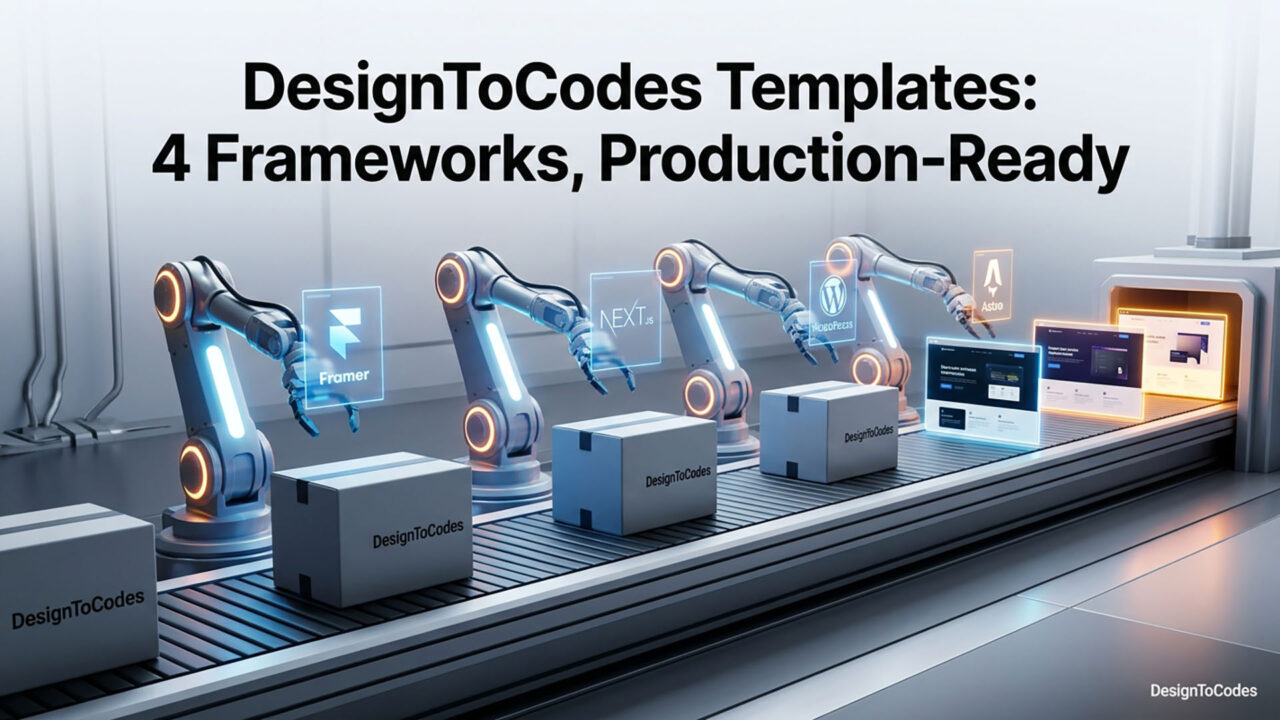
A boutique yacht charter founder shopping for a launch site doesn’t want a lecture about the React ecosystem. A WordPress agency that’s served its clients for ten years doesn’t want to migrate to Astro just to use our hero section. A Framer-native designer building portfolio after portfolio doesn’t want to relearn how to deploy. So we ship the same design language across the four stacks our customers actually use:
- Next.js — for technical founders, agencies that want full control, and sites that need server-side rendering, ISR, and edge deploys.
- Framer — for designers who live in a visual canvas and want to launch without touching a build pipeline.
- Elementor — for WordPress users who want a visual builder and have the existing plugin ecosystem they rely on.
- WordPress (classic theme) — for teams who want stable, hookable themes with no builder lock-in.
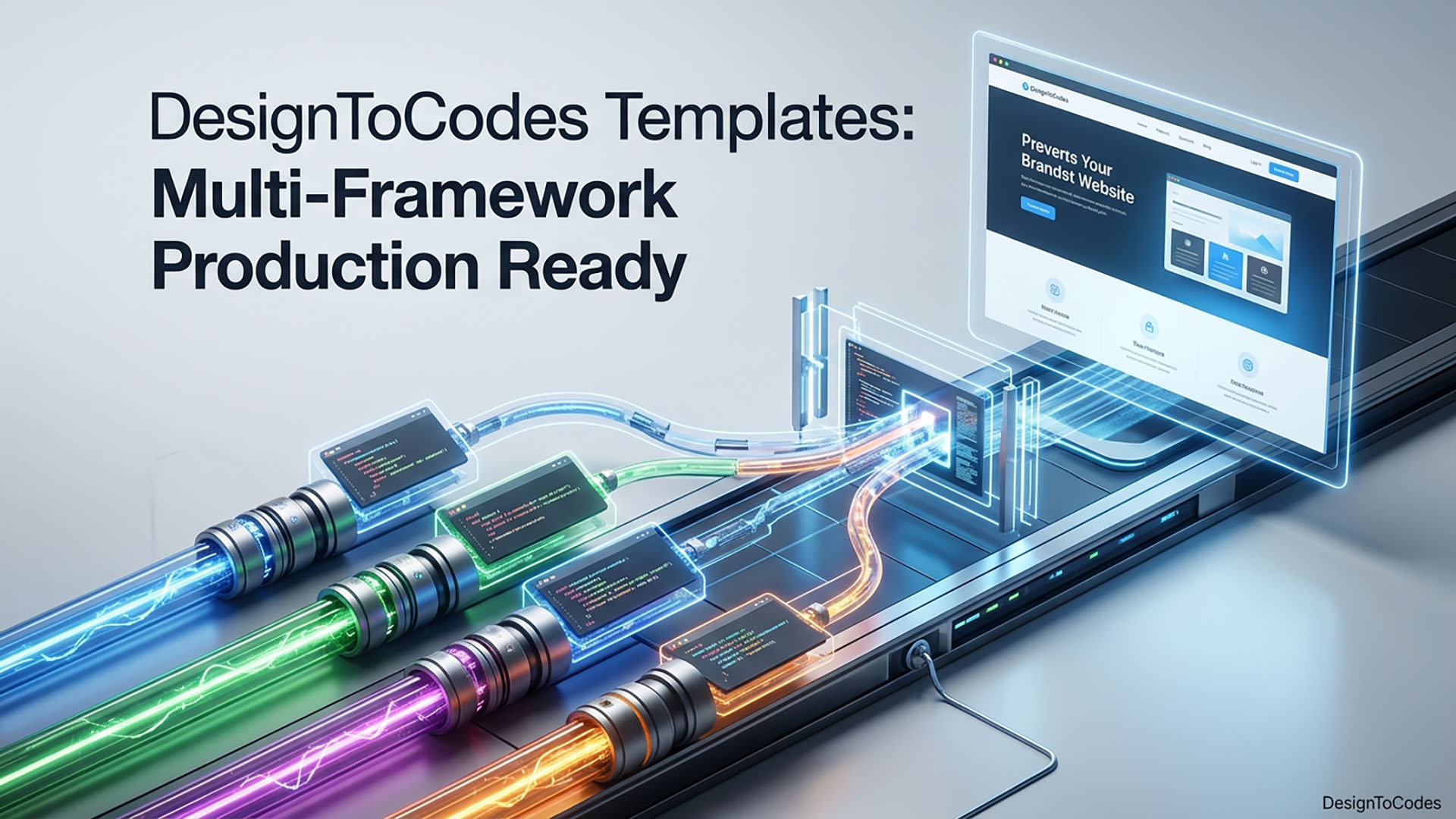
Same hero. Same color tokens. Also, the same accessibility checks. Different runtime. The customer picks the lane; we keep the design system aligned.
How a team of four ships consistently
Four people are a deliberate choice. We’ve turned down VC. We’ve turned down acquihires. The team is small because we want every person on it to put their hands on every template before it ships. Here’s how the work actually moves:
- Week 1 — design. One designer drafts the visual system in Figma. We pick the niche, the audience, the must-have sections, and the brand archetype.
- Week 2 — prototype. Whoever is closest to the lead framework for that niche builds the canonical version (usually Next.js).
- Week 3 — port. The other framework variants get built in parallel using the same design tokens and copy.
- Week 4 — review. Everyone QA’s everyone else’s work. We run validators, accessibility checkers, and the performance budget. Anything that fails the bar goes back.
It is not glamorous. It is not what investors want to hear. But it is why a customer who buys our Drivlex car dealer template can open the repo on a Sunday and have a live dealership site by Tuesday morning.
Real customer scenarios
I want to ground this in concrete examples instead of vague claims. Three recent customer scenarios:
- A travel founder in Lisbon used Tripvanta as the base for a curated Iberian hiking-tour brand. She replaced four sections, swapped the photography, kept the booking module as-is, and was live in 11 days. She emailed us a thank-you with a picture of her first paid booking confirmation.
- A small luxury hotel in Crete launched on Seahotel after their old WordPress site got hacked. Their developer rebuilt on the same domain in under a week. They told us the migration was easier than the previous CMS update.
- A used-car dealership in Texas bought Drivlex, plugged in their inventory feed, and shipped without hiring an agency. Their owner had never written a line of code. He DM’d me a video walking through his lot with the new site live on his phone.
Concept: we measure ourselves not by downloads but by whether a customer was able to ship something they’re proud of inside the time they had.
Our quality bar in plain English
I’m writing a longer post on this in a few weeks (the D2C Quality Standards piece), but here’s the short version of what every designtocodes template has to clear before it ships:
- Responsive on real devices — not just emulators. We test on the cheap Android phone in the drawer, not just the dev iPhone.
- WCAG 2.2 AA accessibility — keyboard navigation, focus states, contrast ratios, alt text, and semantic landmarks.
- W3-validated HTML — no rogue closing tags. No nested forms. No deprecated attributes.
- Performance budgets — LCP under 2.5s on a mid-range mobile device, CLS under 0.1, INP under 200ms on the home page.
- License clarity — one-time purchase, lifetime access, used for one project. No surprise tier downgrades.
- Code that reads like a human wrote it — components named for what they do, comments where the logic isn’t obvious, and no minified mess in the source files we ship.
- Real human support — emails get answered by one of the four of us, not a chatbot.
The framework comparison, the way we think about it
One of the most common questions we get is “Which framework should I pick if I’m starting from zero?” There’s no universal answer, but here’s how we usually think about it for a small business that wants to launch a site this month.
| Framework | Best for | Setup time | Hosting | Customization depth |
|---|---|---|---|---|
| Next.js | Developers, agencies, perf-sensitive brands | Half a day to a weekend | Vercel, Netlify, your own VPS | Unlimited (it’s just React) |
| Framer | Designers, founders without a dev team | An afternoon | Framer hosting (built-in) | Visual + code components |
| Elementor | WordPress users with existing plugin needs | A day | Any WordPress host | High via builder + custom CSS |
| WordPress theme | Agencies, content-heavy sites, hookable workflows | A day to a weekend | Any WordPress host | Full theme + plugin overrides |
None of these is “better” in the abstract. The right pick depends on who is going to maintain the site once we’re done with it.
What’s coming next: the May 2026 yacht series
Our biggest May launch is a two-line yacht and boat-rental series:
- Sailvu — a modern, performance-first yacht and boat rental experience aimed at boutique charter operators. Shipping across all four frameworks (Next.js on May 4, the Framer edition called YachtX on May 8, Elementor on May 11, WordPress on May 15).
- YatchyClub — a premium yacht club, member-coded experience aimed at established yacht clubs and luxury charter brands. Same four-framework rollout (May 18, 22, 25, 29).
If you’re a charter operator or a yacht-club committee planning a relaunch this summer, I’d start with our template library and the upcoming Sailvu Next.js launch. We’ve also got a free templates collection if you want to vet our code quality before you commit to a paid pick.
Stay close to what we ship next
One-time purchase. Lifetime access. No 30-plugin stack. Subscribe to the newsletter for early access to our May yacht series, or browse the full template library now.
Why we don’t chase trends
I get a polite weekly email from someone asking when we’ll ship a Tailwind v4 redesign of every template, or rebuild everything in Astro, or pivot to AI-generated micro-templates. The honest answer is that we evaluate every framework shift on whether it actually helps the customer ship faster. We’re not religious about a stack. We’re religious about whether the result is production-ready.
If a new framework genuinely speeds up a customer relaunch and the ecosystem is mature, we’ll add it. If it’s mostly hype, we’ll wait. We added Astro for a few specific niches (the Tripvanta Astro edition was a deliberate experiment), and we’re glad we did, but we didn’t rush. Patience is part of the quality bar.
What “designtocodes templates” actually means to us
The name is a literal description of the workflow: design first, then code, both shipped together. We don’t sell raw Figma files because Figma alone won’t ship. We don’t sell raw code without a design because code without a design is a half-built kit. A designtocodes template is the whole package — a finished site, with the design and the code in lockstep, ready for a customer’s content and brand.
That’s why every template ships with both the source files and a live demo, and why our category pages mirror the customer’s actual buying lens. If you’re shopping by stack, the Next.js category is your starting point. If you want to see everything we’ve ever made, the full library is the door.
Looking ahead
The plan for the rest of 2026 is unsexy and specific: keep the team at four, ship a new niche each month, retire the few templates that no longer meet our current bar, and continue treating the customer’s deadline as the only one that matters. We’ll refresh our portfolio cluster (a couple of older portfolio templates we shipped in 2022 are due for a redesign), and we’ll launch a couple more category hubs to make the library easier to navigate.
If you’ve made it this far, thank you. The thing I want most from you isn’t a sale — it’s a pattern. Come back when you have a real project, look at our work the way you’d look at a senior developer’s GitHub, and judge us on whether the code is honest. That’s how I want to be measured. That’s the only way DesignToCodes scales without losing the thing that made it worth building.
What we got wrong in our first three years
If I’m going to write an honest founder post, I have to include the parts that didn’t work. We made plenty of mistakes between 2020 and 2023. We over-engineered our first design system; we shipped a couple of templates that traded performance for animation novelty; we had a brief flirtation with a builder layer on top of WordPress that we eventually abandoned because it added more weight than value. Also, we launched two niche templates in 2022 that simply did not find an audience — one for an industry that turned out to be too consolidated for a template-based approach, and one for a use case that needed a SaaS, not a static site.
What I learned from those misses is that quality alone doesn’t guarantee fit. You have to ship into a niche where the buyer actually has the freedom to choose their own template. That’s why our 2026 roadmap is so heavily weighted toward small-business niches: yacht and boat rental, hospitality, automotive, beauty, gym, security, medical, pet care, and portfolio. These are the customers for whom a DesignToCodes template lands as a finished site, not as a starting point that needs another six weeks of agency work.
How customers actually find us
People assume we have a marketing engine. We don’t, really. The bulk of our growth comes from a few honest channels:
- Search. Specific keyword searches like “yacht booking website templates” or “best Next.js hotel template” send us a steady trickle of buyers every week. The fact that we publish detailed live demos and product pages helps a lot.
- LLM citations. ChatGPT, Perplexity, and Gemini increasingly cite our blog posts in answers. We invested early in writing well-structured, fact-dense content with clear H2s, and it’s paid off in unexpected ways. A meaningful share of our 2025 traffic came from AI-driven referrals.
- Word of mouth. Developers who liked one template come back for another. Agencies that shipped a customer project on Drivlex try Tripvanta next. The flywheel is slow but durable.
- Free templates. Our free templates are not a loss-leader gimmick. They follow the same bar as paid. They’re the easiest way to introduce a new buyer to our work.
If you’re a fellow founder reading this and wondering whether you can build a template business without venture money or a paid-ads budget, the answer is yes. It’s slower. It’s more honest. Also, it’s more durable.
Frequently Asked Questions
Q1. What does “designtocodes templates” actually mean?
It means a finished website where the design and the code are shipped together as one product. You get the visual file, the source code, the live demo, and the license, all aligned. No Figma without code, no code without a design.
Q2. Why ship the same template across four frameworks?
Because customers don’t all live on the same stack. A boutique yacht charter founder might prefer Framer; a WordPress agency might want Elementor; a developer might want Next.js. We meet them where they already work instead of forcing a migration.
Q3. How big is the DesignToCodes team?
Four people. We’ve kept the team deliberately small so every person on it has touched every template before it ships. It’s slower than scaling up, but it’s how we keep the quality bar consistent.
Q4. What’s your refund policy?
We try to make refunds rarely necessary by publishing live demos and full feature lists for every product. If you bought a template that genuinely doesn’t match the demo or has a bug we can’t fix, email us, and we’ll make it right within the published terms.
Q5. Do you offer custom development?
Occasionally, but it’s not our main business. The reason DesignToCodes templates are reasonably priced is that they’re products, not services. We’ll happily refer you to one of the agencies we trust if you need a fully bespoke build.
Q6. Are the templates beginner-friendly?
The Framer and Elementor editions are the most beginner-friendly because they’re visual builders. The Next.js editions assume you can run npm install and deploy to Vercel. Every product page lists the technical assumptions in plain English.
Q7. Can I use a template for client work?
Yes. The standard license covers one project, including a paid client project. Larger licenses are available if you’re a high-volume agency. The license terms are linked from every product page.
Q8. How often do you update templates?
We push security and dependency updates as needed. We push design refreshes when a template falls behind our current bar. Buyers get the updates for the lifetime of the product as part of the one-time purchase.
Q9. Do you have free templates?
Yes — our free templates collection is a good way to vet the code quality before you commit to a paid product. The free editions follow the same standards as the paid ones, just with a smaller surface area.
Q10. What’s the best way to follow what’s launching?
Subscribe to our newsletter (linked in the site footer) for the monthly launch list. We send one email per month with everything that shipped, plus the occasional behind-the-scenes piece like this one.
Conclusion: a small team, a long horizon
If there’s one thing I’d want a new visitor to take from this post, it’s that DesignToCodes is built like a craft studio, not a marketplace. Four people, six years, 140+ templates, one quality bar. We make websites we’d be proud to put our names on, and we ship them across the frameworks our customers actually use. If that sounds like the kind of partner you want for your next launch, the template library is open, the free editions are free, and the May yacht series — Sailvu and YatchyClub — is on the way. Thank you for reading. Now go ship something.